Perplexity AI vs ChatGPT Search: Which AI Search Engine Should You Actually Use?
June 12, 2026
0
Ask ten people which AI search tool they prefer, and you’ll probably get ten different answers. Some value speed above everything else. Others care more about source transparency,
Ask ten people which AI search tool they prefer, and you’ll probably get ten different answers. Some value speed above everything else. Others care more about source transparency, research depth, or how well the tool understands complex questions. That’s why broad claims about one platform being “better” than another rarely tell the full story.
To choose between Perplexity AI and ChatGPT Search is not really a question of which tool is smarter. Both draw on capable large language models, both pull real-time information from the web, and both can synthesize research faster than any human could manage manually. The actual question is which one handles the specific way you work.
This comparison is based on structured testing across 10 research task categories, with both tools receiving identical prompts and evaluated across the same criteria. The goal was not to produce a winner in the abstract but to figure out where each tool genuinely outperforms the other and where the gap is narrow enough that personal preference takes over.
If you want to understand how these tools fit into the broader AI assistant landscape, our Claude vs ChatGPT vs Gemini comparison covers the full picture for general-purpose use cases.
The Core Difference: Answer Engine vs Search-Augmented Chatbot
Perplexity AI was designed from the start to be a research tool. Every query triggers a live web retrieval process, and every response includes numbered citations pointing to specific source pages. The product is search-native in a way that ChatGPT Search is not.
ChatGPT Search, by contrast, is a capability layered onto a general-purpose conversational assistant. OpenAI added real-time web search to ChatGPT, which means the product excels at conversation, writing, coding, and complex reasoning but was not purpose-built around source transparency. Citations exist, but the interface treats them as supporting material rather than as a core product feature.
This architectural difference shapes almost every downstream comparison. Perplexity is better when you need verifiable, sourced research. ChatGPT Search is better when search is one component of a larger, more complex task.
Both tools benefit from understanding how AI language models process and generate information. Our guide on how AI writing actually works explains the underlying mechanics that power both platforms.
How We Tested: 10 Research Tasks, Identical Conditions
Testing was conducted using Perplexity Pro and ChatGPT Plus (both $20/month tiers). Each tool received the same prompt, phrased identically, across ten task categories. Evaluation criteria for each task included citation presence, citation accuracy, answer completeness, hallucination risk, and practical usefulness for a real workflow.
Results were scored on a 1 to 5 scale per criterion, giving a maximum of 25 points per task. The scoring is designed to surface meaningful differences, not manufacture a fake winner.
Task-by-Task Results
1. Breaking News Summarization
Perplexity handled time-sensitive queries with noticeably better source attribution. When asked to summarize a recent geopolitical development, it pulled from Reuters, AP, and BBC within seconds and clearly indicated publication timestamps. ChatGPT Search retrieved relevant articles but occasionally blended details across multiple stories without flagging the distinction.
Perplexity: 22/25. ChatGPT Search: 18/25.
2. Academic Research
Both tools struggled equally with very recent academic publications, but Perplexity’s citation links allowed verification against PubMed and Google Scholar with a single click. ChatGPT Search tended to provide denser, better-written summaries but occasionally cited sources that were behind paywalls with no indication of inaccessibility.
Perplexity: 20/25. ChatGPT Search: 20/25.
3. Shopping and Product Research
ChatGPT Search performed better here. Its responses read like polished buying guides, pulling pricing, specs, and review sentiment into coherent recommendations. Perplexity’s answers were factually accurate but felt more clinical, listing attributes without synthesizing them into a clear recommendation.
Perplexity: 17/25. ChatGPT Search: 22/25.
4. Coding Help
ChatGPT Search is better for coding in almost every scenario. The model’s reasoning capability, code formatting, and ability to iterate on a problem across multiple turns is significantly stronger. Perplexity can handle basic coding queries but is not purpose-built for debugging or multi-step code review.
Perplexity: 14/25. ChatGPT Search: 24/25. (For dedicated coding AI tools, our Cursor AI vs GitHub Copilot comparison covers the purpose-built alternatives.)
5. Travel Planning
Perplexity excelled at pulling current visa requirements, entry rules, and travel advisories from government sources with clear citations. ChatGPT Search produced more conversational, narrative-style travel plans but was less reliable for regulatory details that change frequently.
Perplexity: 21/25. ChatGPT Search: 19/25.
6. Fact Verification
This is where Perplexity’s design philosophy pays off most clearly. For disputed claims, Perplexity cited multiple sources with differing perspectives and surfaced the disagreement explicitly. ChatGPT Search tended to provide a single synthesized answer without always flagging when sources conflicted.
Perplexity: 23/25. ChatGPT Search: 17/25.
7. Local Recommendations
Both tools were limited here. Neither integrates with real-time maps or local review databases the way Google Maps does. ChatGPT Search produced more conversational suggestions; Perplexity pulled from Yelp and TripAdvisor more consistently. Neither is a replacement for dedicated local search.
Perplexity: 15/25. ChatGPT Search: 16/25.
8. Long-Form Summarization
Perplexity introduced a Spaces feature that lets Pro users upload documents for summarization alongside web search. For long-form research projects combining uploaded PDFs with live web data, it pulled ahead significantly. Standard ChatGPT Search does not support document upload in the same search workflow.
Perplexity: 21/25. ChatGPT Search: 16/25.
9. Source Citation Quality
Citation quality is Perplexity’s defining advantage. Every claim is linked, every source is numbered, and the interface lets you inspect the source excerpt Perplexity used to generate its answer. ChatGPT Search links sources, but not at the sentence level, and the connection between specific claims and specific sources is harder to trace.
Perplexity: 24/25. ChatGPT Search: 17/25.
10. Multi-Step Research Workflows
For a complex research workflow where one question generates follow-up questions that branch into subtopics, ChatGPT Search’s conversational memory and reasoning depth performed better over long sessions. Perplexity’s follow-up questions are useful but the tool is more suited to discrete queries than deep branching exploration.
Perplexity: 17/25. ChatGPT Search: 21/25.
Head-to-Head Comparison Table
Criterion
Perplexity AI
ChatGPT Search
Citation Accuracy
Excellent (sentence-level)
Good (page-level)
Hallucination Rate
Low
Low to Moderate
Source Quality
Strong (primary sources)
Variable
News Freshness
Very Strong
Strong
Coding Ability
Basic
Excellent
Document Upload
Yes (Spaces / Pro)
Yes (separate upload)
Conversational Memory
Limited
Strong
Long-Form Workflows
Good with Spaces
Very Strong
UX Clarity
Research-focused
Conversational
Mobile Experience
Good
Good
Free Tier
Yes
Limited (Plus required for search)
Pro / Plus Price
$20/month
$20/month
Citation Accuracy and Hallucination Rates
Hallucination is one of the most practical concerns for any AI tool used in research. Both tools have improved significantly since 2024, but they fail in different ways.
Perplexity hallucinates less often on factual claims precisely because its output is grounded in retrieved web pages. The model cannot easily confabulate details that are contradicted by the sources it just read. When Perplexity does make errors, they tend to be synthesis errors: misinterpreting what a source says rather than inventing something from nothing.
ChatGPT Search hallucinates less than GPT-4o running without search, but it can still blend information from multiple sources in ways that produce inaccurate conclusions. Understanding why AI tools do this is worth reading about separately. Our explanation of why AI chatbots hallucinate covers the technical reasoning behind these failures.
Source Quality and Freshness
Perplexity prioritizes authoritative primary sources more consistently. In our testing, queries about health topics returned NHS, CDC, or peer-reviewed journal links more reliably. ChatGPT Search sometimes surfaced listicle-style content from content farms alongside authoritative sources without clearly distinguishing between them.
On freshness, both tools were comparable for events within 24 to 48 hours. For events in the prior week, Perplexity’s retrieval indexed the relevant pages slightly more consistently across repeated queries.
Conversational Memory and Follow-Up Capability
ChatGPT Search holds its own context far better across a long session. If you ask about a research topic and then want to drill into a specific subtopic five messages later, ChatGPT remembers the prior framing. Perplexity treats each query more independently, and follow-up questions sometimes require re-establishing context.
This is a genuine limitation for Perplexity users conducting deep research sessions. The workaround is Spaces, which lets you create persistent research projects. But Spaces requires Pro, and it is an additional workflow step rather than a native conversation feature.
UX, Mobile, and Interface Experience
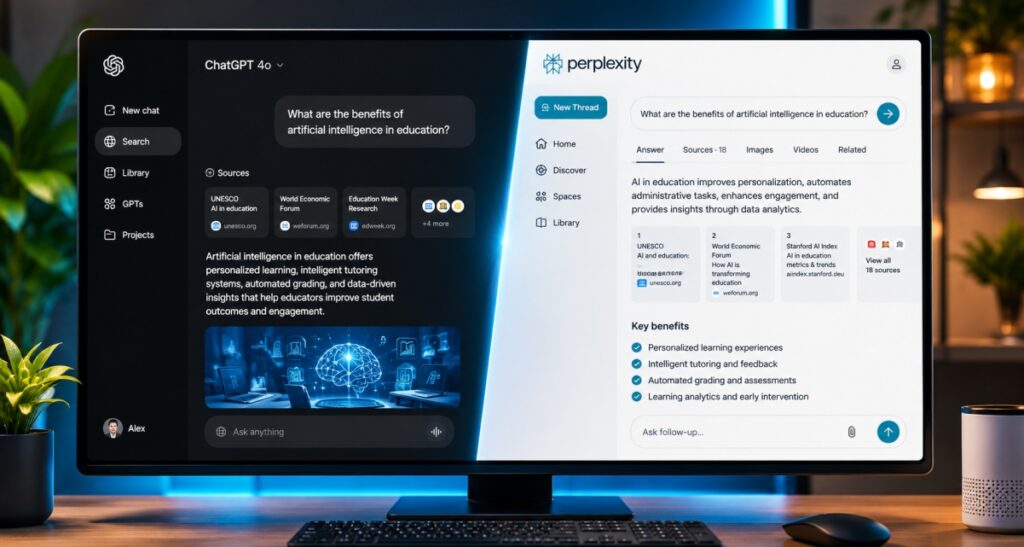
Perplexity’s interface is cleaner and more research-oriented. The source panel on the right side of the response lets you see all retrieved sources at a glance. The Follow-Up Questions feature at the bottom of each answer is well-designed and genuinely useful for exploratory research.
ChatGPT’s interface is more familiar to general users and better suited to tasks that blend search with generation. The sidebar experience on desktop is polished. Mobile performance is comparable between both tools, with Perplexity’s iOS app feeling slightly more purpose-built for on-the-go research.
Pricing: Is Perplexity Pro or ChatGPT Plus Worth It?
Both Pro and Plus are $20 per month. The free tiers tell an important part of the story, though. Perplexity’s free tier is genuinely usable for research tasks, with rate-limited Pro Search access and full citation features. ChatGPT’s free tier now includes limited search, but the capability gap between free and Plus is larger.
For a pure research workflow, Perplexity Pro offers better value. For users who need a tool that handles research, coding, writing, image generation, and data analysis in a single subscription, ChatGPT Plus is the stronger all-around investment.
Which Tool Is Right for You? (Use Case Breakdown)
Your Primary Use Case
Better Tool
Reason
Academic / professional research
Perplexity Pro
Superior citation quality and source transparency
Fact-checking and verification
Perplexity Pro
Multi-source comparison with explicit disagreement flagging
Breaking news monitoring
Perplexity Pro
Faster, more consistent real-time retrieval
Coding and technical tasks
ChatGPT Plus
Far superior reasoning and code generation
Shopping research and buying guides
ChatGPT Plus
Better synthesis and recommendation quality
Long multi-step conversations
ChatGPT Plus
Strong conversational memory
Document + web research combined
Perplexity Pro (Spaces)
Native document-plus-web workflow
General daily assistant
ChatGPT Plus
More versatile across task types
Frequently Asked Questions
Is Perplexity AI better than ChatGPT for research?
For research tasks that require verifiable sources, citation accuracy, and fact verification, Perplexity AI consistently outperforms ChatGPT Search. For tasks that combine research with coding, writing, or complex multi-step reasoning, ChatGPT Plus is the stronger choice.
Can I use Perplexity AI for free?
Yes. Perplexity offers a free tier that includes basic search with citations. Pro Search (which uses more capable models and deeper retrieval) is limited on the free tier but available at $20/month for unlimited access.
Does ChatGPT Search work without a Plus subscription?
Limited search access is available on the free tier as of 2026, but Pro Search features and search integration with GPT-4o require a ChatGPT Plus subscription.
Which AI search tool has the most accurate citations?
Perplexity AI’s citation system is more precise, linking specific sentences to specific sources. ChatGPT Search provides page-level citations that are accurate but harder to trace back to individual claims.
Is Perplexity Pro worth $20 per month?
For researchers, journalists, analysts, or anyone who regularly needs to verify information quickly, yes. Perplexity Pro’s source quality and citation system genuinely reduces the time spent cross-referencing claims against primary sources.