ElevenLabs Review 2026: The AI Voice Generator That’s Becoming a Standard Tool
June 13, 2026
0
Nobody expected an AI voice tool to sound this good this fast. When ElevenLabs launched in 2022, the gap between what they were producing and every other text-to-speech
Nobody expected an AI voice tool to sound this good this fast.
When ElevenLabs launched in 2022, the gap between what they were producing and every other text-to-speech tool on the market was jarring. Other platforms gave you the robotic cadence that had defined TTS for two decades. ElevenLabs gave you something that sounded like a person who had been asked to read something, not a program executing a phoneme table.
By 2026, the field has caught up somewhat. Murf AI, Play.ht, and Descript have all improved. But ElevenLabs has not stood still either, and it remains the benchmark against which most buyers evaluate everything else.
This review tests ElevenLabs across six real-world production scenarios: podcast narration, character voices, video voiceovers, audiobook narration, customer service, and multilingual generation. It also covers pricing, clone quality, ease of use, and honest comparisons to the main alternatives. The goal is to help you decide whether it belongs in your workflow.
What Is ElevenLabs?
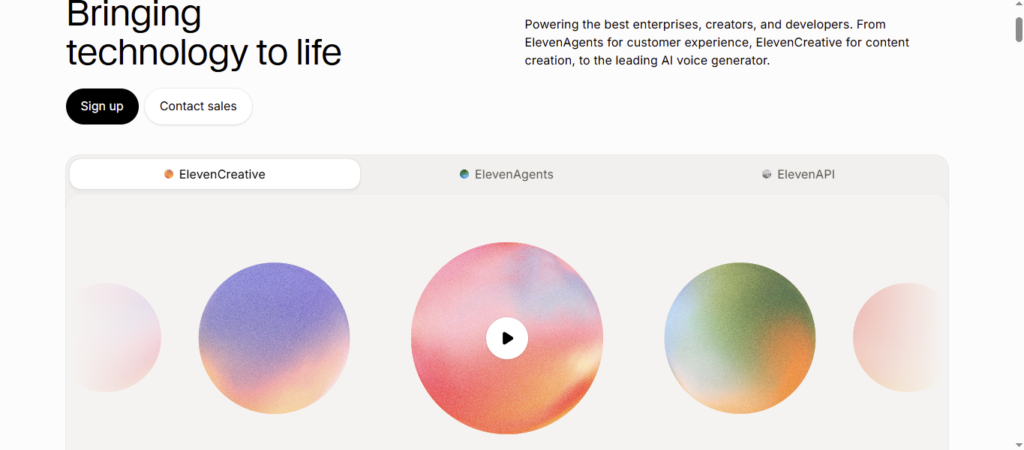
ElevenLabs is an AI voice synthesis platform that converts written text into spoken audio. Its core technology is a neural voice model that generates speech with natural pacing, emotion, and intonation rather than the mechanical tone characteristic of older TTS systems.
The platform has three primary capabilities: voice generation from a library of pre-built voices, voice cloning from audio samples you upload, and a multilingual engine supporting 29 languages. The speech synthesis model, Eleven Multilingual v2 (their current flagship), is trained to handle the emotional and contextual nuance of how humans actually speak rather than just mapping text to phonemes.
How It Works
Input is text. Output is audio in MP3 or WAV format. Generation takes seconds for typical lengths. You choose from the voice library, adjust stability (consistency) and similarity boost (how closely the output matches the voice profile), and export. The platform is entirely browser-based; no software installation is required.
Voice cloning uses a minimum of one minute of clean audio for an instant clone, though higher-quality results come from longer, cleaner source material. Professional voice clones (available on higher tiers) use significantly more data and produce a closer match to the source voice.
Who Built It and Why It Matters
ElevenLabs was founded in 2022 by Piotr Dabkowski and Mati Staniszewski, both former machine learning engineers. The company has grown quickly, reached unicorn valuation in 2024, and is backed by investors including Andreessen Horowitz. The backing and growth pace matter for enterprise buyers who need to know a vendor will still exist in two years and can invest in model quality.
ElevenLabs Pricing 2026: Plans, Limits, and Value
Plan
Monthly Price
Characters/Month
Key Feature
Free
$0
10,000
Basic voice library, no commercial use
Starter
$5
30,000
Commercial use, voice cloning
Creator
$22
100,000
Instant voice cloning, 30 custom voices
Pro
$99
500,000
Professional voice cloning, 160 voices
Scale
$330
2,000,000
High-volume, API access, 660 voices
Enterprise
Custom
Custom
Dedicated support, SLAs, custom models
Free Tier
The free tier gives you 10,000 characters per month, which is roughly 7-10 minutes of generated audio depending on speech rate. It is useful for serious evaluation but not production use. Free tier output cannot be used commercially.
Starter, Creator, Pro, and Scale Plans
The Starter plan at $5/month is genuinely cheap for what it includes: commercial use rights and voice cloning access. It’s the right entry point for freelancers doing occasional voiceover work who need commercial licensing without a large monthly commitment.
Creator at $22/month is where most solo content creators land. The 100,000 character limit covers around 70-100 minutes of audio per month, enough for a weekly podcast or several YouTube videos. Instant voice cloning and 30 custom voice slots are included.
Pro at $99/month unlocks professional voice clones, which produce notably better results than instant clones for voices requiring high accuracy. The 500,000 character limit and 160 voice slots make this the right tier for agencies or high-volume individual creators.
Is There a Discount or Annual Deal?
ElevenLabs offers annual billing discounts. At time of writing, annual plans reduce the monthly equivalent cost by approximately 22% across most tiers. For committed users, the annual Creator plan represents one of the better value propositions in the AI audio tools category.
Voice Quality Testing: Six Real-World Use Cases
Each use case below was tested using ElevenLabs’ current flagship model, Eleven Multilingual v2, with settings adjusted per use case. Results reflect production-level evaluation, not quick demo tests.
Podcast Narration
ElevenLabs performs exceptionally well for solo podcast narration. Pre-built voices in the library, particularly the Bella, Rachel, and Josh profiles, handle long-form spoken content with natural pacing variation and appropriate pause behavior at sentence boundaries.
The biggest practical advantage over competitors here is handling of lists and structured content. Where other TTS tools often flatten everything to the same pace regardless of sentence type, ElevenLabs adapts delivery to contextual cues. Questions get appropriate rising intonation. Emphasis words get heavier delivery.
For narration-forward podcast formats (commentary, essay-style, explainers), ElevenLabs is production-ready. For interview formats, you are still working with a voice synthesizer, not a conversational AI, so you’re generating scripted content rather than spontaneous response.
Score: 9/10
Character Voices for Games and Fiction
This is one of ElevenLabs’ strongest verticals. The platform offers a wide range of voice profiles with different tonal qualities, and voice design allows you to describe characteristics (gruff, young, elderly, whispering) to generate new voice profiles to spec.
For indie game developers and fiction creators, the practical value is high. Instead of paying professional voice actors for short-run projects or placeholder audio, creators can generate character audio that sounds credible enough for early production stages. Many indie developers use ElevenLabs for final audio on lower-dialogue characters while reserving professional casting for primary characters.
Voice consistency across long scripts is strong. The same voice profile generates consistent audio across sessions, which matters for characters with extended dialogue.
Score: 8.5/10
Video Voiceovers
Video voiceover is probably the most common use case among ElevenLabs’ user base, and the results justify the popularity. Script-to-voiceover generation is fast and natural-sounding. For YouTube content, explainers, and social media videos, the output quality is good enough that audiences rarely identify it as AI-generated on casual listening.
Where things get technical is sync. ElevenLabs does not have a built-in video editor, so you’re working with exported audio that you manually sync to video in your editing software. This is standard workflow for anyone already using Premiere, DaVinci Resolve, or CapCut, but it’s worth noting for users who want a one-stop production tool.
For users who want a more integrated experience, the ElevenLabs integration with video tools via API or third-party connections (Descript, for example) can reduce friction significantly. Our comparison of
AI productivity tools that streamline content creation workflows cover several options that pair well with ElevenLabs for end-to-end video production.
Score: 8.5/10
Audiobook Narration
Long-form narration is where the quality ceiling becomes more visible. ElevenLabs handles chapters and multi-hour content well, but a few consistent behaviors show at scale: occasional slightly mechanical emphasis patterns on technical vocabulary, rare but noticeable pacing resets at section breaks, and a tendency toward consistent delivery tempo that experienced human narrators vary more deliberately.
For short to mid-length nonfiction (business books, self-help, how-to guides), ElevenLabs output is strong enough for commercial release, particularly when paired with post-processing. For narrative fiction with complex dialogue attribution, managing multiple voices and maintaining character consistency across 80,000 words requires careful setup and checking.
The professional voice cloning feature (Pro tier and above) significantly improves results for users cloning their own voice for personal brand audiobooks. The clone quality at that tier is genuinely impressive, and many authors find the result indistinguishable from their own delivery on casual listening.
Score: 7.5/10
Customer Service Applications
Enterprise and developer users deploying ElevenLabs for customer service voice applications via the API get a different value proposition from the content creator use cases above. The key metrics for CS applications are latency, consistency, and conversational naturalness.
ElevenLabs’ streaming API delivers low-latency audio, which is essential for interactive voice applications where users expect responses in real time rather than waiting for a full audio file to generate. The Turbo v2 model is specifically optimized for latency-sensitive applications at the cost of some voice quality.
For straightforward IVR replacement and structured customer service scripts, ElevenLabs is well-suited. For genuinely conversational customer service agents (where the AI is also deciding what to say), you’re combining ElevenLabs with a language model and a conversation management layer, which involves more integration work.
Score: 8/10
Multilingual Voice Generation
The Eleven Multilingual v2 model supports 29 languages with quality that varies by language. English, Spanish, French, German, and Portuguese perform at near-native levels with appropriate prosody and accent patterns. Less-represented languages show more artificial patterns, though quality continues to improve with model updates.
Cross-lingual cloning, where you clone a voice in one language and generate in another, works surprisingly well for the major supported languages. This is particularly useful for content creators targeting international audiences who want to maintain a consistent voice persona across language versions of their content.
Score: 8/10
Performance Ratings Summary
Category
Rating
Notes
Voice Realism
9/10
Among the most natural-sounding TTS available
Naturalness
9/10
Prosody and intonation feel human in most contexts
Clone Quality
8.5/10
Professional clones (Pro+) are exceptional
Ease of Use
9/10
Clean interface, minimal learning curve
Performance (Speed)
8.5/10
Fast generation; Turbo v2 for latency-sensitive use
Pricing
7.5/10
Competitive but costs scale with volume
Value for Money
8.5/10
Strong value, especially Creator and Pro tiers
ElevenLabs vs Alternatives: How Does It Compare?
Feature
ElevenLabs
Murf AI
Play.ht
Descript
Voice Realism
Excellent
Very Good
Good
Good
Voice Library Size
3,000+
120+
900+
Limited
Voice Cloning
Yes (all paid)
Yes (higher tiers)
Yes
Yes
Multilingual Support
29 languages
20 languages
142 languages
Limited
API Access
Yes
Yes
Yes
Limited
Starting Price
$5/month
$19/month
$31/month
$12/month
Best For
Quality & cloning
Studio-style narration
Language breadth
Audio editing
ElevenLabs vs Murf AI
Murf AI is the most frequently compared alternative and targets a similar professional audience. Murf produces strong, consistent narration voices and has a more integrated studio editing experience. The tradeoff is voice realism: ElevenLabs edges Murf on naturalness, particularly for emotional content and long-form narration. Murf is more expensive at entry-level; the lowest Murf paid plan starts at $19/month versus ElevenLabs’ $5/month Starter.
ElevenLabs vs Play.ht
Play.ht’s advantage is language breadth: 142 languages versus ElevenLabs’ 29. For global content teams needing voice in less-common languages, Play.ht often has better coverage. For English-primary content where quality is the priority, ElevenLabs wins consistently on voice naturalness. Play.ht’s entry pricing is higher than ElevenLabs’ Starter tier.
ElevenLabs vs Descript
Descript is not a direct competitor; it’s a video and audio editing platform with an AI voice feature called Overdub. The comparison comes up because Descript users want to know whether switching to ElevenLabs for voice generation is worthwhile. The honest answer is that ElevenLabs’ core voice generation is significantly better than Overdub, but Descript’s integrated editing workflow is its actual value. Many creators use both: ElevenLabs for voice generation, Descript for editing.
For a broader view of how AI audio tools fit into a complete content workflow, our article on th best AI video generators in 2026 covers complementary tools that pair well with ElevenLabs.
Pros and Cons
Strengths
Best-in-class voice realism for English-language content
Voice cloning quality is exceptional at Pro tier and above
Large, diverse voice library with realistic character voice design
Clean, fast interface with minimal learning curve
Strong API for developers building voice applications
Commercial use rights available from $5/month
Consistent cross-session voice performance for character work
Weaknesses
Character costs scale quickly for high-volume production
No built-in video sync or editing workflow
Free tier excludes commercial use, limiting real evaluation
Long-form audiobook output shows slight mechanical patterns at scale
Multilingual quality drops noticeably for less-represented languages
Professional voice cloning requires Pro tier ($99/month) for best results
Who Should Use ElevenLabs?
YouTube creators and video producers who need consistent voiceover at volume
Authors and publishers producing audiobooks, particularly nonfiction
Indie game developers needing character voice audio
Agencies producing multilingual content across major European and Spanish-speaking markets
Developers building voice applications and customer service systems via API
Content creators who want to clone and scale their own voice across multiple projects
Who Should Avoid It?
Users who need voice generation in obscure languages where Play.ht has better coverage
Teams with tight budgets producing more than 500,000 characters/month who would find the Pro tier expensive
Users who want a fully integrated video-to-voiceover tool with editing built in (Descript may fit better)
Interview-style podcast producers whose format doesn’t lend itself to TTS generation
Frequently Asked Questions
Is ElevenLabs free to use?
Yes, there is a free tier offering 10,000 characters per month. Free tier output is for personal, non-commercial use only. To use generated audio in monetized content, you need at least the $5/month Starter plan.
Can I use ElevenLabs for commercial projects?
Yes, all paid plans include commercial use rights. This covers YouTube monetization, client work, and commercial production. Enterprise plans include additional licensing terms for high-stakes commercial applications.
How accurate is ElevenLabs voice cloning?
Instant clones (available from Creator tier) produce usable results from as little as one minute of audio. Professional clones (Pro tier and above) produce significantly higher accuracy and are the right option when the clone needs to closely match the source voice for commercial use.
Does ElevenLabs work in multiple languages?
Yes. Eleven Multilingual v2 supports 29 languages including Spanish, French, German, Portuguese, Italian, Polish, Hindi, and others. Quality varies by language, with the strongest results in English and Western European languages.
What is the difference between ElevenLabs and traditional TTS?
Traditional TTS maps text to phonemes using rule-based synthesis. ElevenLabs uses a neural model trained on human speech to generate audio that reflects natural emotional tone, pacing, and emphasis. The difference is perceptible to most listeners, particularly in longer-form content.
Final Verdict
ElevenLabs earns its position as the default recommendation for anyone asking which AI voice generator to start with. The voice quality is genuinely the best available for English-language content, the pricing structure is competitive from entry to scale, and the cloning capability at Pro tier is one of the more impressive things in the AI tools space right now.
The limitations are real but specific. If you are generating at very high volume and cost becomes a constraint, if you need less-common language support beyond ElevenLabs’ 29 languages, or if you want a fully integrated editing workflow, those factors might point you elsewhere. For the majority of content creators, agencies, and developers, none of those limitations apply.
The Starter plan at $5/month with commercial use rights is the right place to begin. Generate a few hundred lines of real script from your actual projects and evaluate the output in context. That test will tell you more than any review.
For context on how ElevenLabs fits within the broader AI tool landscape for content creators, see the