What Are AI Agents? A Plain-English Explanation of the Biggest Trend in Tech Right Now
June 15, 2026
1
Your GPS app does not just store maps. When you miss a turn, it doesn’t throw up its hands. It recalculates, checks traffic conditions, considers alternate routes, and
Your GPS app does not just store maps. When you miss a turn, it doesn’t throw up its hands. It recalculates, checks traffic conditions, considers alternate routes, and gives you a new instruction. It perceives the situation, decides what to do, and acts. It’s doing a tiny version of what AI agents do.
AI agents are the technology everyone in the industry is talking about in 2026, and not without reason. They represent a genuine shift in what AI systems can do: from answering questions to completing tasks. From responding to instructions to pursuing goals.
This article explains what AI agents actually are, how they work, how they’re different from chatbots and traditional automation, and what they’re actually being used for right now. The goal is clarity, not hype.
Quick Answer: What Is an AI Agent?
An AI agent is a system that uses an AI model to pursue a goal by planning, taking actions, and adjusting based on results, without needing a human to direct each step.
The key difference from a standard AI chatbot is autonomy over multiple steps. A chatbot responds to what you ask. An agent figures out what needs to happen to achieve an objective and does those things in sequence, using whatever tools are available.
A chatbot answers: “Here is a list of research papers on this topic.”
An agent does: searches for relevant papers, reads them, extracts the key findings, cross-references them, writes a summary document, and saves it to your Google Drive.
Same underlying AI model. Fundamentally different scope of what it can accomplish.
How AI Agents Work: The Mechanics Without the Jargon
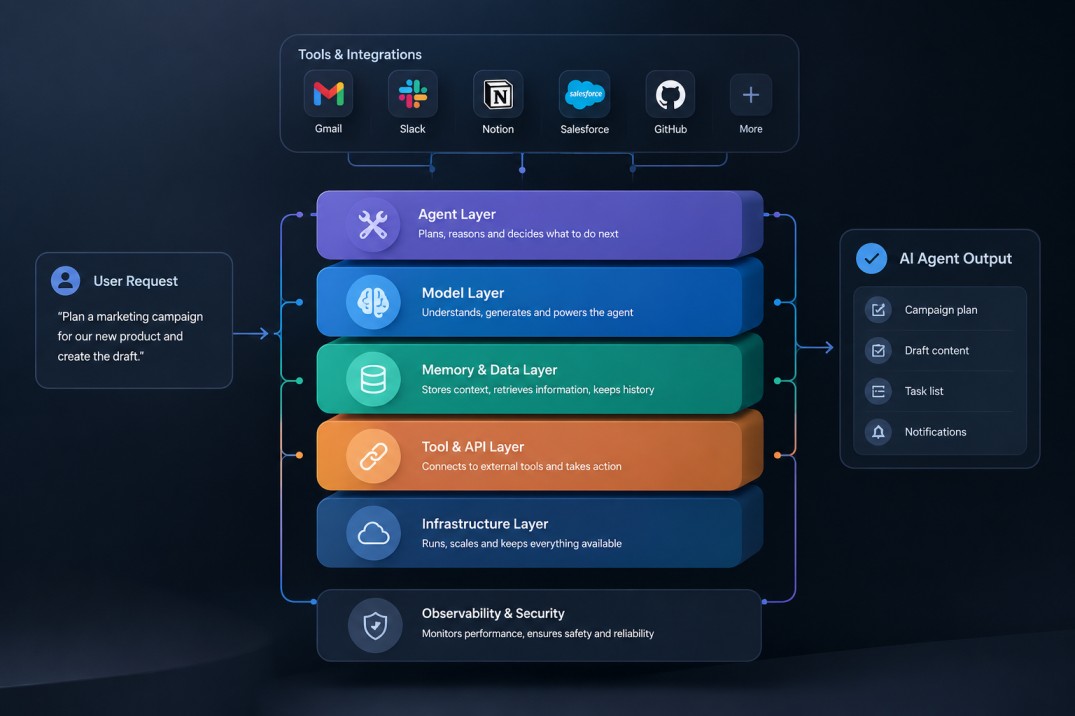
Most AI agents follow a cycle with four stages. Understanding this loop explains a lot about both what agents can do and where they break down.
Perceive: Gathering Information
An agent starts by taking in information about its current situation and goal. This might be a user instruction, data from a file, results from a previous step, web search results, output from a code execution, or input from any connected system. The agent’s context window is its working memory for this stage.
Reason: Deciding What to Do
This is where the language model does its work. The agent evaluates what it knows, what it needs to achieve, and what steps would get it there. Modern agents use a reasoning approach called ReAct (Reason + Act), where the model explicitly reasons about the problem before choosing an action. This produces better decisions than directly jumping to output.
More advanced agentic frameworks use chain-of-thought reasoning and, in multi-step tasks, maintain a plan that they update as the task progresses.
Act: Using Tools to Do It
Actions are how agents interact with the world outside the model. Tools are the capabilities available to the agent, and they vary enormously by system: web search, code execution, file reading and writing, form submission, API calls, sending messages, clicking buttons in a browser, running database queries. The range of tools available directly determines what an agent can actually accomplish.
An agent without tools is just a chatbot. The tools are what give the agent real-world reach.
Learn: Updating Based on Feedback
After taking an action, the agent receives feedback, which becomes new perception input for the next cycle. A code execution returned an error. A web search returned zero results. A file save succeeded. The agent incorporates this feedback into its next reasoning step. This loop continues until the goal is achieved, or the agent determines it cannot proceed and flags the issue for human review.
AI Agents vs Chatbots: What’s the Actual Difference?
Dimension
AI Chatbot
AI Agent
Scope
Single response to a single input
Multi-step task toward a goal
Memory
Current conversation only
Maintains state across steps
Tools
Usually none (text output only)
Web, code, files, APIs, browsers
Autonomy
Responds when asked
Operates until goal is complete
Error handling
Flags issues in its response
Attempts to route around problems
Best for
Questions and conversation
Tasks and workflows
The same underlying AI model can power both. ChatGPT in standard conversation mode is a chatbot. ChatGPT configured with tools and instructed to complete a research task autonomously is behaving as an agent.
The distinction is not about the AI’s intelligence, it’s about how the system is designed to use that intelligence.
AI Agents vs Traditional Automation: Not the Same Thing
This is a confusion that comes up often, particularly in business contexts where both are being evaluated for workflow automation.
Traditional automation (RPA, Zapier workflows, if-this-then-that rules) executes predefined logic. It is rigid, predictable, and brittle. Change the structure of the source document, and the automation breaks. Encounter an edge case outside the rules, and it fails.
AI agents handle ambiguity. They can read a document whose format they’ve never seen before and extract the relevant information. They can encounter an unexpected error and decide how to work around it. And they can be given a goal in natural language and figure out the steps themselves.
The tradeoff is predictability. Traditional automation is highly reliable for narrow, well-defined tasks. AI agents are more flexible but less deterministic, they won’t always take exactly the same path to the same goal. For regulated industries and compliance-sensitive workflows, this matters significantly.
Most production deployments in 2026 use a hybrid approach: traditional automation for the parts of a workflow where rigid consistency is required, AI agents for the ambiguous, judgment-requiring steps in between.
AI Agents vs Workflows: Where the Lines Blur
This distinction matters to the people building agentic systems more than to end users, but it’s worth understanding.
A workflow is a predetermined sequence of steps. Even when AI is involved in individual steps (summarize this document, generate this email), if the sequence is fixed and predetermined, it’s a workflow, not an agent.
An agent is adaptive. It decides which steps to take based on the goal and what it has learned from previous steps. It can choose from a set of available actions rather than executing a fixed script.
The practical blurring happens because many systems called “agents” are actually sophisticated workflows with branching logic. True agentic behavior means the system is genuinely deciding how to pursue a goal, not just picking from a decision tree.
Real-World Use Cases: AI Agents in Action
The following use cases represent areas where AI agents are currently deployed in production environments, not theoretical applications.
Coding Agents
Coding agents are among the most mature agentic applications available in 2026. Tools like Cursor, GitHub Copilot Workspace, and Devin operate as agents within a development environment: they read the codebase, understand the task, write code, run tests, read the test results, and iterate until the tests pass.
The practical value for developers is working on the hardest parts of a problem while the agent handles implementation of components that follow established patterns. Rather than asking an AI for a code suggestion and then implementing it, developers can assign a subtask and review the result.
Research agents take a research question, search for relevant sources, read them, extract key information, cross-reference findings across sources, and produce a structured output. Perplexity AI’s Deep Research feature is a consumer-accessible version of this. Enterprise tools go further, accessing proprietary databases, reading PDFs, and integrating with citation managers.
For analysts, writers, and researchers who currently spend hours on literature reviews and competitive analysis, research agents can compress that time significantly. The outputs require human review and fact-checking, but the raw information gathering phase can be largely automated.
Customer Service Agents
Customer service agents handle tier-1 support interactions autonomously: reading the customer’s inquiry, accessing the company’s knowledge base and order management system, determining the appropriate resolution, and either executing it or escalating to a human when needed.
The key advantage over traditional chatbots is handling ambiguous requests. A customer who writes “my thing doesn’t work” without specifying what product or what symptoms they’re seeing would confuse a traditional chatbot. An agent can ask the right clarifying questions, look up the customer’s purchase history, and arrive at a resolution path.
According to Gartner’s research on AI in customer service, enterprises deploying agentic AI in service workflows are reporting meaningful reductions in average handle time for tier-1 inquiries.
Marketing Agents
Marketing agents are being used for tasks like competitive intelligence gathering (monitoring competitor websites, pricing pages, and announcements), social media monitoring and response drafting, and personalized content generation at scale.
The more advanced applications involve multi-step campaign analysis: an agent that pulls performance data from ad platforms, identifies underperforming segments, generates variant copy for A/B testing, and submits the test variants for approval, all without a human initiating each step.
Productivity Agents
Personal productivity agents integrate with your email, calendar, documents, and task management tools to handle scheduling, email triage, meeting summaries, and task follow-up. Products like Claude, ChatGPT, and Gemini are all pushing toward agentic productivity features in their consumer products.
For knowledge workers, the value case is clearest in high-volume information management: an agent that reads your inbox, categorizes messages by urgency, drafts responses for your review, and flags anything requiring immediate attention can meaningfully reduce cognitive load on repetitive inbox management.
If you’re evaluating AI productivity tools more broadly, our article on the best AI productivity tools for 2026 covers the leading options across categories.
How to Think About Agentic AI: A Mental Model
Think of an AI agent as a capable new hire who has read everything but has never done anything. They’re smart, they learn quickly, they can figure out how to do things they haven’t done before, but they need their work reviewed, especially early on.
You wouldn’t hand a new hire your company’s production database credentials on day one and walk away. But you would assign them tasks with real outputs and review the results. As they demonstrate reliable judgment, you extend more autonomy.
That’s approximately how production AI agents are managed right now. The technology is capable enough to be genuinely useful, but the current best practice is human-in-the-loop at decision points rather than fully autonomous operation in high-stakes environments.
OpenAI’s research on agentic systems describes this as a spectrum from fully supervised to fully autonomous, with most current deployments operating toward the supervised end. The autonomous end is technically achievable but trust needs to be built incrementally.
Understanding limitations is as important as understanding capabilities. In 2026, AI agents consistently struggle with:
Long-horizon tasks that require dozens of interdependent steps without human checkpoints
Tasks requiring genuine real-world judgment that differs significantly from training data patterns
Reliably handling novel error states they have no pattern for resolving
Operating consistently in environments where the tools or interfaces change frequently
Tasks requiring true causal understanding rather than pattern matching at scale
Most production failures come from over-extension: assigning an agent a task that falls just outside its reliable competence range, leading to plausible-looking but incorrect outputs. The countermeasure is human review at defined checkpoints rather than pure end-to-end automation.
Frequently Asked Questions
Are AI agents the same as large language models?
No. A large language model (LLM) is the underlying AI that generates text. An AI agent is a system built around an LLM that adds tools, memory management, and a control loop that allows the LLM to take actions toward a goal. The LLM is the brain; the agent architecture is the body.
Do I need to be technical to use AI agents?
For consumer products like ChatGPT Tasks, Claude, or Perplexity Deep Research, no technical skills are required. For building custom agents that integrate with your own systems, some technical understanding of APIs and prompting is helpful. Developer frameworks like LangChain, CrewAI, and AutoGen are available for those building from scratch.
Are AI agents reliable enough for business use?
For well-defined use cases with clear success criteria and human review, yes. For high-stakes, fully autonomous operation with no human checkpoints, current agents are not consistently reliable enough. Most successful business deployments combine agentic AI with human oversight at defined decision points.
What is a multi-agent system?
A multi-agent system uses multiple AI agents that communicate and collaborate to complete a task. One agent might specialize in research, another in writing, another in review. The agents pass work between each other rather than a single agent doing everything. This approach allows parallelization and specialization for complex tasks.
How is agentic AI different from automation tools like Zapier?
Zapier and similar tools execute predetermined logic: if X happens, do Y. They’re rigid and predictable. AI agents handle ambiguity and make judgment calls. They can be given a goal and figure out the steps, rather than executing a predefined workflow. The practical difference is that agents handle tasks that don’t fit clean if-then rules.
Final Say
AI agents are not a future technology. They’re a current one, deployed in production across customer service, software development, research, and productivity applications right now.
What they are not, yet, is fully autonomous and fully reliable across arbitrary tasks. The most effective use of AI agents today treats them like skilled collaborators rather than set-and-forget systems: powerful when well-directed, requiring oversight at key decision points, and best evaluated by the quality of their outputs rather than the novelty of their autonomy.
The tools are genuinely useful. The hype around them is occasionally disconnected from what they currently deliver. The gap between the two is closing faster than most observers expected.
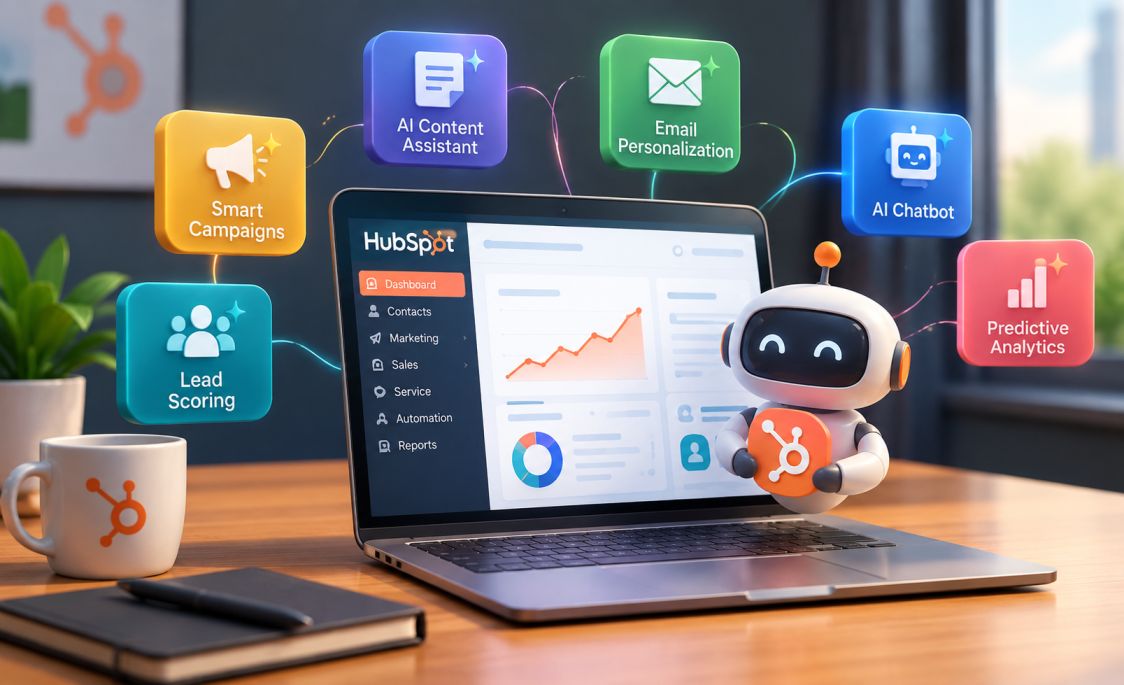
[…] are HubSpot’s answer to the broader shift toward AI agents that don’t just answer questions but complete multi-step jobs on their own. HubSpot’s agents […]






1 Comment
[…] are HubSpot’s answer to the broader shift toward AI agents that don’t just answer questions but complete multi-step jobs on their own. HubSpot’s agents […]