ChatGPT vs Claude for Writing: Which Is Better for Your Workflow?
- October 24, 2026
- 0
Start with Claude Opus 5.5 if you want clear drafts that follow your style rules. Start with ChatGPT on GPT-6.1 Sol or GPT-6 Astra if your work ends

Start with Claude Opus 5.5 if you want clear drafts that follow your style rules. Start with ChatGPT on GPT-6.1 Sol or GPT-6 Astra if your work ends
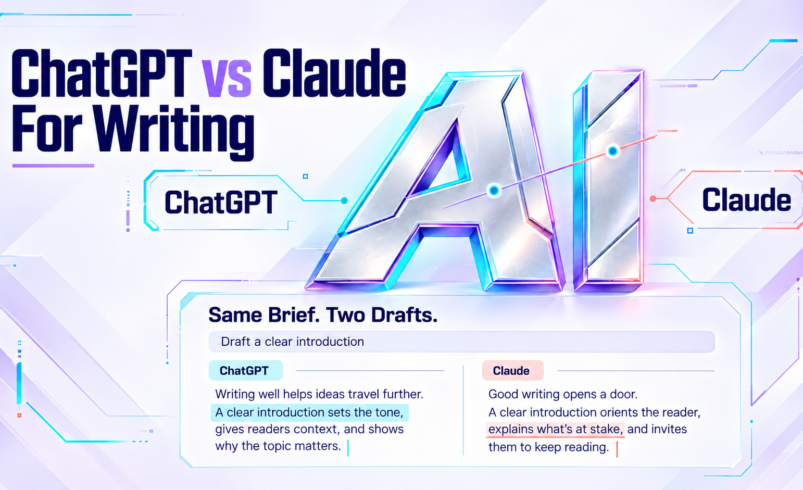
Start with Claude Opus 5.5 if you want clear drafts that follow your style rules. Start with ChatGPT on GPT-6.1 Sol or GPT-6 Astra if your work ends in finished files. For light editing and proofreading, the current models are nearly tied.
Both lineups changed this fall. Anthropic released Claude Fable 5.1 on September 15, Opus 5.5 on September 22, and Sonnet 5.5 on September 28. OpenAI’s ChatGPT now runs on the GPT-6 family: Astra, Sol, and Luna, plus the newer GPT-6.1 Sol.
The ChatGPT vs Claude for writing question now comes down to which of these models leaves you less to fix. This comparison uses published tests on the new models plus official documentation and pricing checked on October 24, 2026.
| Model | Who gets it in the app | Positioning |
| Claude Fable 5.1 | Pro (usage credits), Max, Team premium seats, Enterprise | Anthropic’s most capable model for long, demanding work |
| Claude Opus 5.5 | Pro and above | Matches Fable 5.1 on most work; writing “clearer and easier to follow” |
| Claude Sonnet 5.5 | All plans, including Free | Faster; “writes more clearly” than the previous generation |
| GPT-6 Astra | Plus and above, 5–45 messages per five hours on Plus | OpenAI’s “most capable model for complex work” |
| GPT-6.1 Sol | Plus, Pro, Business, Enterprise, Edu | “Near-Astra performance” at lower cost, for long document work |
| GPT-6 Luna | All plans, including Free | Most efficient; built for summaries and extraction |
Plan access comes from Claude pricing and OpenAI’s models page. Anthropic makes the stronger writing claims: it says Opus 5.5 “puts the most important information up front” and “follows the writing rules you give it.” OpenAI’s GPT-6 pages make no writing-specific claims; the closest is that Astra is “better at asking focused questions and incorporating your guidance.”
Fable’s October 4 test ran the new models through the same edits on a 199-word fiction passage, using 46 API calls. Fable is a voice-editing app that runs on Claude models, unrelated to Claude Fable 5.1, and it discloses that bias.
| Model | “Tighten” (words kept) | “Make it colder” (words kept) |
| Claude Opus 5.5 | 93% | 54% |
| Claude Sonnet 5.5 | 93% | 68% |
| GPT-6 Astra | 95% | 43% |
| GPT-6.1 Sol | 95% | 45% |
| GPT-6 Luna | 91% | 61% |
On light edits, the models are effectively tied. The tone edit splits them. Opus 5.5 made the passage colder by giving the narrator an attitude. GPT-6 Astra changed the register and wrote “like a report.” Sonnet 5.5 changed the least, mostly cutting interior commentary. If you want your voice kept through a tone change, Sonnet 5.5 is the most conservative; if you want a full rewrite, the GPT-6 models go furthest.
Claude Fable 5.1 was not in the test because no API provider offered it on test day. Of the older models tested, only Claude Haiku 4.5 stood out, for adding eight em dashes nobody asked for.
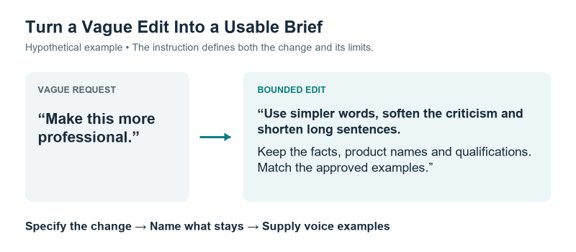
Whatever model you use, replace vague directions such as “more professional” with specific ones: simpler vocabulary, softer criticism, shorter sentences. Name what must stay unchanged, and paste two or three approved passages to keep brand voice consistency.
Revise’s ErrataBench, updated October 14, seeds documents with errors and measures how many each model fixes correctly across 4,620 runs.
Two older models still top their brands: GPT-5.6 Sol at 96.5% and Claude Opus 5 at 95.7%. The gap between these AI editing tools matters less than the errors an edit introduces, so check whether a change strengthened a claim beyond its source, removed a qualification, or altered a product name. For dedicated grammar checkers, see our Grammarly vs Hemingway vs ProWritingAid comparison.
No published same-brief drafting test covers the new models yet. The most recent, Anobee’s August 26 test, used Claude Sonnet 5 against an unnamed ChatGPT Plus model. Claude stayed inside a 450–550-word limit with a tighter argument but put the required headings in bold text. ChatGPT followed the headings and ran past 550 words. Anthropic’s claim that Opus 5.5 follows writing rules more closely targets exactly that formatting miss.
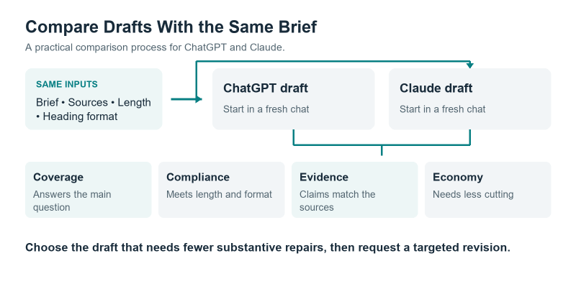
Run your own version in fresh chats on both tools with the same brief, sources, and length. Then score each draft on:
Pick the draft that needs fewer substantive repairs, then give a bounded revision: “Cut this section under 300 words. Keep the facts, links, and headings. Flag anything that needs verification.”
The new models close the old context gap. Anthropic lists a 1-million-token context window in the Claude app for Fable 5.1, Opus 5.5, Sonnet 5.5, and Haiku 5.5, up from 500K on Fable 5 and 200K on older models. OpenAI lists 1.05 million tokens with 128K output for GPT-6 Astra, Sol, and Luna in its API, though it doesn’t publish a ChatGPT-specific figure. Either holds a book manuscript plus research notes.
Both tools store project instructions and files. ChatGPT Projects allow 25 files per project on Plus and 40 on Pro. Claude Projects are on every plan, with up to five on Free. Store the approved outline, verified facts, preferred terms, and sample passages there, then revise one section at a time. For a full research-to-publish process, see our guide to building an AI workflow.
ChatGPT can create, preview, and refine documents, presentations, spreadsheets, and PDFs, and annotations let you point at one part of a preview and request a focused revision. OpenAI positions GPT-6.1 Sol for “repeated, long-running work across code, apps, and documents,” which makes it the practical default for client deliverables on Plus.
Claude Docs gives you a rich-text document you can edit directly or revise with Claude, with comments, @Claude mentions, and real-time co-editing. It is on by default on every plan and exports to Word, PDF, Markdown, and Google Docs. Team and Enterprise documents can’t be shared outside the organization by link, so client review needs an export. Anthropic says Sonnet 5.5 is strongest at “creating polished documents, slides, and spreadsheets.”
ChatGPT has built-in web search and a Deep research plugin that produces a sourced report. Claude’s web search works on all plans, and Research, which runs on Opus 5.5, needs a paid plan.
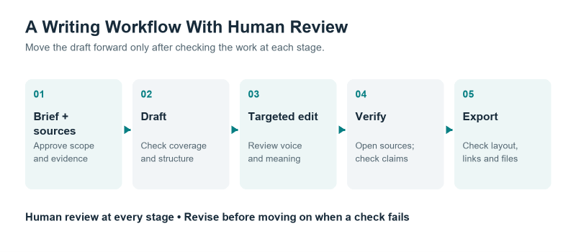
A citation is where checking starts. Open the source, find the passage behind the sentence, check the date and plan, and cut what the source doesn’t support. For why fabricated details slip through, read why AI chatbots hallucinate.
| Plan | Price | Writing models |
| ChatGPT Free | $0 | GPT-6 Luna |
| ChatGPT Plus | $20/month | GPT-6.1 Sol, GPT-6 Astra, GPT-6 Luna |
| ChatGPT Pro | From $100/month | Everything in Plus, no five-hour limit |
| Claude Free | $0 | Sonnet 5.5, Haiku 5.5 |
| Claude Pro | $20/month or $200/year | Opus 5.5, Sonnet 5.5; Fable 5.1 via usage credits |
| Claude Max | From $100/month | All models; Fable 5.1 up to 50% of weekly limits |
Sources: OpenAI pricing and Claude pricing, checked October 24, 2026. Paid tiers on both have weekly limits. On free plans, Claude has the edge for writers: Claude Free gets Sonnet 5.5, while ChatGPT Free gets the efficiency-tier GPT-6 Luna.
The ChatGPT vs Claude for writing choice comes down to where your time goes. Choose Claude Pro with Opus 5.5 for drafts that follow your style rules and for tone edits that keep your voice. Choose ChatGPT Plus with GPT-6.1 Sol when you need finished files from the same chat. For pure proofreading, GPT-6 Astra has a small lead.
For Claude vs ChatGPT for content creation at volume, one subscription is enough. To compare other AI writing tools, see our Unlucid AI alternatives for SEO content and our broader Claude vs ChatGPT vs Gemini comparison.
Not for most writing. Anthropic says Opus 5.5 performs at Fable 5.1’s level on most work, and the two scored 94.9% and 94.7% on ErrataBench. Fable 5.1 costs more and is rationed on Pro and Max.
Fable’s fiction test found the new models close on light edits. Opus 5.5 changes a narrator’s attitude, GPT-6 Astra changes register, and Sonnet 5.5 changes the least. Test them on your own material.
Start with one. In the ChatGPT vs Claude for writing decision, add the second only if it handles a recurring task with noticeably fewer corrections.