

What Is an AI Agent Stack? The Tools Top Teams Are Building
- September 8, 2026
- 0
An AI agent stack is the set of layers sitting between a raw model call and an agent that can plan, use tools, hold state, and finish a
An AI agent stack is the set of layers sitting between a raw model call and an agent that can plan, use tools, hold state, and finish a
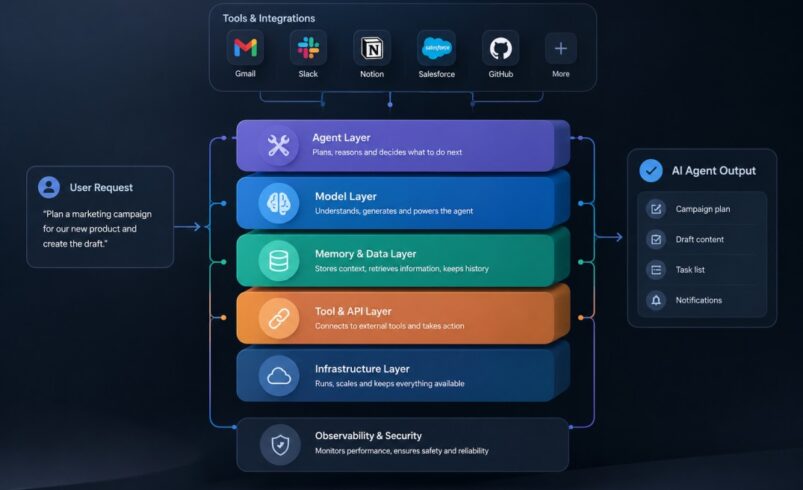
An AI agent stack is the set of layers sitting between a raw model call and an agent that can plan, use tools, hold state, and finish a task with only light supervision. Most teams building one end up with either far less stack than they need or a lot more. A support bot gets wired to a vector database it rarely queries. A one-tool automation script gets bolted onto a full orchestration framework meant for a dozen cooperating agents. Both versions technically run. Both also take longer to ship and cost more than they should have.
This piece walks through what belongs in each layer of the stack, what changed in the tooling landscape through 2026, and how to figure out which layers your specific agent actually needs before you write any code.
An agent stack is not the model, and it is not a single prompt with a clever system message. A model provides the reasoning. The stack is everything that turns that reasoning into something that can act on a real task, recover when a tool call fails, and hold enough context to finish a job that spans several steps.
The term “agent” gets used loosely enough that it’s worth drawing the line. A chatbot answering questions from a fixed prompt is calling a model, not running an agent stack. Something becomes agentic once it can choose which tool to use, carry state from one step to the next, and change its plan based on what those tools return. That shift, from a single call to a multi-step loop with tools attached, is what actually forces a team to start thinking in terms of a stack.
This is the reasoning core, and credible options now come from OpenAI, Anthropic, Google, Meta, and Mistral. It’s also the most commoditized layer in the stack and the one most likely to shift under a team’s feet within a few months. Building logic that depends heavily on one model’s specific quirks tends to be a costly early mistake, since swapping providers later usually means rewriting prompt logic written around a particular model’s habits.
This layer manages what happens between one model call and the next. LangGraph, CrewAI, and Microsoft Agent Framework all live here. Their job is deciding what step runs next, routing between sub-agents, retrying failed tool calls, and checkpointing state so a long task can pick back up after an interruption. A single-purpose agent calling one API rarely needs a full graph framework for this. A workflow with branching logic, several tools, and failure paths that need explicit handling usually does.
This layer determines what the agent can actually do outside of talking. The Model Context Protocol, or MCP, has reshaped this part of the stack more than anything else in the past two years. Before MCP, every tool integration had to be custom-built per model provider. MCP gives an agent a standard way to discover and call external tools and data sources, and that’s a big part of why it moved from a new Anthropic-authored spec in late 2024 to a default expectation on most agent projects by 2026. Adoption reports now put monthly SDK downloads in the tens of millions, with most enterprise AI teams running at least one MCP-connected agent in production. Direct function calling still works fine for a small, fixed list of tools. MCP earns its place once that list grows or needs to be shared across more than one agent.
Memory is what an agent carries forward on its own, separate from anything it looks up externally. A user’s stated preference, what happened three turns ago, what’s already been tried and failed. This is why purpose-built memory tools such as Mem0, Letta, and Zep exist now. Bolting persistent state onto a vector database turned out to be the wrong shape for the job. A tool that resets after each conversation doesn’t need this layer at all. An agent meant to improve or personalize across sessions does.
In practice this is retrieval-augmented generation, and VertexTechHub has already covered what RAG is and why it matters in enough depth that repeating the mechanics here would be redundant. What actually matters for stack decisions is simpler. If the agent needs to answer questions about something specific, current, or private that wasn’t in its training data, this layer is required. If it doesn’t, adding a vector database anyway is one of the more common ways early agent builds pick up weight they didn’t need.
This is where a team finds out whether the agent is actually working, and it’s also the widest known gap in the industry right now. Agent behavior is probabilistic and multi-step, so a clean response code says almost nothing about whether the reasoning underneath it was sound. LangChain’s own research on the state of agent engineering has found that most teams running production agents have basic tracing set up, but far fewer have real evaluation pipelines behind that tracing. That gap between watching an agent run and actually grading what it produced is where quality problems tend to hide. LangSmith, Langfuse, and Arize Phoenix sit in this category, alongside a newer set of agent-native platforms built specifically to trace multi-step, multi-tool sessions rather than single model calls.
Once a model can choose which tool to call, tool execution turns into a security surface in a way it never was for a plain chat interface. This layer covers permission scoping, defenses against prompt injection, output filtering, and human approval steps for anything high-stakes. It’s also the layer skipped most often in early prototypes, and the one that causes the most damage when a prototype quietly becomes a production system without anyone adding it back in.
This is where a person actually meets the agent, and that surface has expanded well past a chat window by 2026. Agents now live inside IDEs as coding harnesses, inside Slack threads, inside browsers, and inside approval queues. VertexTechHub covers this ground closely for developer tools already, through its comparison of Cursor, Windsurf, and Claude Code and its dedicated Claude Code review. Both are effectively deep dives on one specific interface choice, a coding harness where the agent loop ships fused directly into the surface itself.
The pattern shows up almost the same way every time. A team starts with a narrow, real problem, say, answering refund questions out of a support inbox. Someone reaches for a full orchestration framework because it looked authoritative in a comparison article somewhere. A few weeks later the project has a dozen graph nodes, a custom retry system, and a checkpointer writing to a database, all wrapped around an agent that calls one API and answers one category of question. A fifty-line script with two tool calls would have shipped the same result faster and stayed far easier to debug once something broke.
None of this is an argument against frameworks. LangGraph, CrewAI, and Microsoft Agent Framework, which became Microsoft’s recommended path after AutoGen moved into maintenance mode in late 2025, all solve genuine problems once an agent has multiple steps, branching logic, or several cooperating sub-agents. The issue is sequencing. Complexity should get added when a specific, named problem shows up in front of you, not as a default starting position.
Before adding any layer beyond the model itself, a few questions do most of the useful filtering.
Does the agent need to remember anything between sessions? If not, skip the memory layer outright. A single-session tool has no use for persistent state, and adding it anyway just gives the team another system to maintain for no real benefit.
Does the agent need private, current, or domain-specific knowledge to answer correctly? If yes, the retrieval layer isn’t optional, and the quality of that layer will matter more than which orchestration framework sits next to it. If no, resist adding a vector database just because a competitor’s architecture diagram has one.
What happens when the agent gets something wrong, and who notices first? A low-stakes internal drafting tool can run on light guardrails and manual spot checks. An agent that can issue refunds, send external emails, or touch production data needs approval steps, permission scoping, and real observability before it goes anywhere near live traffic. The size of the blast radius, not how sophisticated the use case sounds, is what should set the bar for guardrails and evaluation.
Different agents genuinely need different stacks. These four patterns cover most of what teams are shipping in 2026.
A lightweight internal automation agent needs one model, a handful of direct tool integrations or a small MCP server, and basic logging. No memory layer, no vector database, no multi-agent orchestration. This is the right shape for a script that triages internal tickets or drafts a weekly summary from a fixed set of sources. Bringing in a framework here mostly adds new places for bugs to hide.
A customer support agent needs more. A model, an orchestration framework for handling branching conversations and escalation paths, a retrieval layer over the knowledge base and past ticket history, session memory so the agent doesn’t lose the thread mid-conversation, and observability running from day one, since support agents interact with real customers and quiet quality drift gets expensive fast. Guardrails matter here too, especially around what the agent can promise or refund without a human signing off.
A coding agent is a different shape entirely, dominated by tools where the interface and the agent loop ship as one package. VertexTechHub covers this directly in its guide to AI coding assistants. The stack decision that actually matters here has less to do with orchestration frameworks and more to do with tool access, how much of the filesystem, terminal, and version control system the agent can touch, and what guardrails sit around destructive actions like force pushes or dependency changes.
A multi-agent enterprise workflow is where the full stack tends to show up. An orchestration framework managing several specialized sub-agents, a shared memory and retrieval layer so those agents aren’t working off inconsistent context, MCP-based tool access so new systems can be connected without custom integrations for each one, and both observability and governance running as layers across the whole system instead of bolted onto a single agent. This is also the pattern most likely to get applied to problems that don’t actually need it, so it’s worth confirming a single well-scoped agent genuinely can’t do the job before committing to a multi-agent design.
Three paths show up in practice, and picking between them comes down to how differentiated the agent’s actual behavior needs to be.
A fully custom stack, open-source frameworks wired together in-house, gives the most control and the least vendor lock-in, at the cost of engineering time spent on plumbing instead of the problem the agent was built to solve. A managed agent platform trades some of that flexibility for speed, since orchestration, memory, and observability arrive pre-integrated, though it also ties the team more closely to that platform’s roadmap and pricing over time. A hybrid setup, open-source orchestration paired with a managed observability or model layer, is what most production teams actually settle on, since it keeps the pieces most likely to need customization in-house while offloading the ones that don’t differentiate the product at all.
The honest test here is whether the agent’s value comes from something proprietary in how it reasons or acts, in which case building that core yourself is worth the effort, or whether the value comes from applying a fairly standard agent pattern to a specific business problem, in which case a managed platform gets there faster with less risk attached.
A credible picture of the agent stack has to include what goes wrong, because none of these layers make an agent effortless to run.
Tool failures and flaky APIs hit an agent harder than a traditional app, since the agent has to notice the failure and decide what to do about it instead of just surfacing an error to a person. Retrieval quality problems are quiet by nature. A RAG system pulling loosely related documents doesn’t throw an exception, it just produces confidently wrong answers. Poor state management shows up as an agent that loses track of what it was doing partway through a longer task. Prompt injection and data leakage are real risks anywhere an agent reads untrusted content, a web page or an incoming email, and then has permission to act on what it read.
Costs tend to creep in through two channels that are easy to miss during a prototype. The first is token usage in multi-step agents, where a task that looks cheap per call adds up fast once an agent starts retrying, re-planning, or calling several tools in a single turn. The second is the observability and evaluation tooling itself, often free at prototype scale and a real budget line once trace volume and eval runs grow with production traffic. Vendor lock-in is the quieter cost of the three. Framework choice, memory provider, and observability platform are all more portable than they look if a team keeps them loosely coupled from the start, and considerably harder to move once a year of production data and tracing history is sitting inside one platform.
The smallest stack that solves the real problem in front of you is the right one to start with. That usually means a model, a small number of well-scoped tools, and basic logging, with memory, retrieval, orchestration frameworks, and multi-agent coordination added only once a specific, observed limitation makes the case for them. Teams that work this way end up spending their early effort on the part of the agent that’s genuinely hard to get right, the tool design and the guardrails around it, instead of on infrastructure the project may never grow into.
Do I need a framework like LangGraph or CrewAI to build an agent?
No. A single well-scoped agent with a few direct tool calls can run on a plain script against a model provider’s SDK. Orchestration frameworks earn their place once there’s branching logic, multiple cooperating agents, or a real need for checkpointed, resumable state.
Is MCP required to build an agent stack?
Not required, but increasingly the default. For a small, fixed set of tools, direct function calling still works fine. MCP becomes worth the setup once the tool list grows, needs to be reused across agents, or gets maintained by a different team than the one building the agent.
What’s the actual difference between an agent’s memory and RAG?
Retrieval brings in external knowledge the agent looks up on demand, documents, a knowledge base, past records. Memory is the agent’s own persistent state about a specific user or task, carried forward across turns or sessions. An agent might need one, both, or neither, depending on what it’s actually built to do.