AI vs Machine Learning vs Deep Learning: What’s the Actual Difference?
May 5, 2026
0
Few topics in tech produce more confident confusion than the relationship between artificial intelligence, machine learning, and deep learning. These three terms appear in headlines, product announcements, and
Few topics in tech produce more confident confusion than the relationship between artificial intelligence, machine learning, and deep learning. These three terms appear in headlines, product announcements, and investor pitches almost interchangeably, despite describing genuinely distinct things.
The confusion isn’t entirely the public’s fault. Even within the industry, the terms often get used loosely or strategically. “AI” in a marketing context can mean anything from a simple rule-based sorting algorithm to a billion-parameter neural network capable of generating photorealistic images.
But the underlying concepts are clear. And once you understand how these three categories actually relate to each other, a huge amount of tech news, product coverage, and industry discussion starts making significantly more sense.
Why These Terms Get Mixed Up (And Why It Matters)
Part of the problem is historical: the term “AI” has been in use since the 1950s and has been applied to so many different types of systems over seven decades that it now carries almost no specific technical meaning without context.
Part of it is commercial: “AI-powered” sounds more exciting than “machine learning-based” or “uses a decision tree,” so vendors apply the broadest label possible.
The practical consequence is that people using these terms interchangeably often have fundamentally different things in mind. One person saying “AI” means the current wave of large language models and image generators. Another means any computer system that performs intelligent-seeming tasks. A third is thinking about robots and science fiction.
Understanding the precise relationship between these terms gives you a stable reference point amid that noise.
The Nested Relationship — One Simple Framework
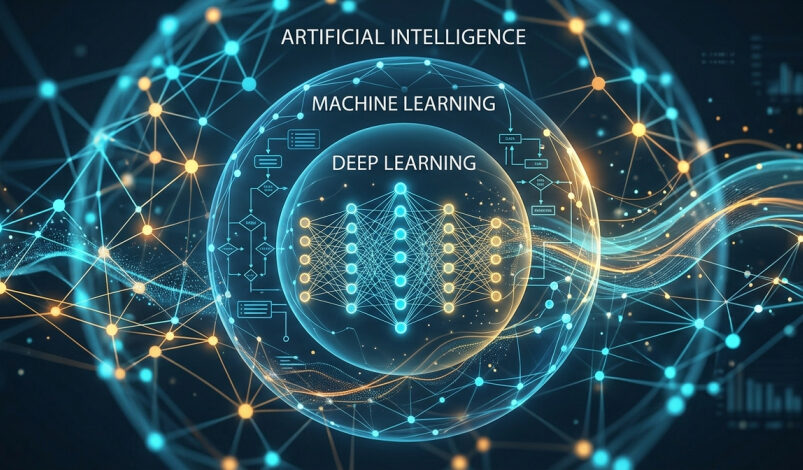
Think of three concentric circles. The largest, outermost circle is Artificial Intelligence, the broadest category. Inside it sits a smaller circle labeled Machine Learning, a specific approach to building AI systems. Inside that sits the smallest circle, Deep Learning, a specific type of machine learning.
A Diagram in Words
AI = the umbrella term for any computer system designed to perform tasks requiring human-like intelligence
Machine Learning ⊂ AI = the specific approach where systems learn from data rather than following explicit rules
Deep Learning ⊂ Machine Learning ⊂ AI = machine learning using multi-layer artificial neural networks
Everything that’s machine learning is AI. Everything that’s deep learning is machine learning. But not everything called AI is machine learning, and not everything machine learning is deep learning.
What Is Artificial Intelligence?
The Broad Definition
At its most fundamental, artificial intelligence refers to any computational system designed to perform tasks that would typically require human-level reasoning, judgment, or perception.
That’s intentionally broad and it covers an enormous range of systems across eight decades of development.
Classical AI vs Modern AI
Early AI, dating from the 1950s through the 1980s, had nothing to do with statistical learning. These were rule-based systems: programmers explicitly encoded logical rules that told the computer exactly what to do in every scenario they could anticipate. The rules were written by humans, applied deterministically, and required the programmer to understand and encode every possible case.
Expert systems which is a prominent form of classical AI prominent in the 1980s, tried to encode the decision-making processes of human specialists into formal rule sets. A medical expert system might contain thousands of if-then rules representing a clinician’s diagnostic reasoning. By the strict historical definition, this was AI.
A chess program from 1972 that evaluates board positions using hand-crafted heuristics? AI. A spam filter checking for specific keywords? Also AI, by the broad definition. Neither involves any machine learning.
What Falls Under the AI Umbrella
Modern usage has narrowed the popular meaning considerably. When people say “AI” in 2025–2026, they almost always mean machine learning-based systems, particularly the large language models and image generators that have dominated public attention since 2022. But the broader historical definition still exists, and it’s worth keeping in mind to avoid confusion when older systems are described as “AI.”
What Is Machine Learning?
Machine learning is a specific approach to building AI systems, characterized by one defining principle: instead of programming explicit rules, you provide the system with data and let it learn patterns from that data on its own.
The Key Difference from Classical AI
In traditional programming, a developer writes explicit logic: “If the email contains ‘free money’ and ‘wire transfer,’ flag it as spam.” The developer has to anticipate every possible case and encode the decision rule manually.
In machine learning, you show the system thousands of spam emails. And thousands of legitimate emails, and the system learns to distinguish between them by discovering patterns in the data, often patterns far more nuanced than any human would think to encode manually.
This shift has enormous practical implications. Tasks that are easy for humans but nearly impossible to program explicitly include recognizing faces in photos, transcribing speech, and translating between languages. It becomes tractable when you can learn the mapping from millions of examples rather than specifying it by hand.
Three Types of Machine Learning
Supervised learning is the most widely deployed. You provide labeled training examples, each input paired with the correct output, and the model learns to generalize that mapping to new inputs it hasn’t seen. Image classifiers, sentiment analyzers, credit scoring models, and medical diagnosis tools are predominantly supervised learning systems.
Unsupervised learning operates without labeled data. The model finds structure in raw data on its own — clustering similar items, identifying patterns, or compressing information into more compact representations. Customer segmentation, anomaly detection in security systems, and certain recommendation algorithms use unsupervised or semi-supervised approaches.
Reinforcement learning trains an agent through interaction with an environment. The agent takes actions, receives rewards or penalties based on outcomes, and gradually learns strategies that maximize cumulative reward over time. This is how AI systems learned to play chess, Go, and video games at superhuman levels — and how robotic systems learn physical tasks.
Real-World Machine Learning Examples
The algorithm deciding which YouTube videos appear in your feed: machine learning
The fraud detection system flagging unusual charges on your credit card: machine learning
The model predicting whether a loan applicant will default: machine learning
Email filters separating spam from legitimate messages: machine learning
What Is Deep Learning?
Deep learning is machine learning using a specific class of models: artificial neural networks with many layers — hence the word “deep.” Everything that qualifies as deep learning is machine learning, but the reverse is not true. Plenty of effective machine learning doesn’t use neural networks at all.
Why It’s a Subset of Machine Learning
Before deep learning dominated the field, many machine learning tasks relied on simpler algorithms, such as decision trees, support vector machines, logistic regression, and gradient boosting. These methods still work extremely well for many problems, particularly with structured tabular data, and remain widely deployed in industry. Deep learning’s advantages become pronounced specifically when dealing with unstructured data (images, audio, text) and when very large datasets are available.
How Neural Networks Actually Work (Simply)
Artificial neural networks are loosely inspired by the connected structure of neurons in biological brains, though the analogy shouldn’t be pushed too far. Artificial neurons are mathematical functions: they take numerical inputs, apply learned weights to those inputs, and produce an output that gets passed to the next layer of neurons.
Stack many layers of these neurons and train the whole structure on enough data, and the network learns to represent increasingly abstract features of the input. In an image recognition system, early layers might detect edges and textures. Middle layers detect shapes and object parts. Later layers detect high-level concepts like “face” or “car.” None of these representations were explicitly programmed — they emerge from training.
What Made Deep Learning Take Off
The ingredients for deep learning’s dominance converged around the early 2010s: dramatically larger datasets (fueled by the internet), significantly more computing power (the repurposing of GPUs for neural network training), and algorithmic improvements in training stability. The crystallizing moment came in 2012, when a deep neural network called AlexNet won the ImageNet image recognition competition by a margin so large it shocked the research community and triggered a fundamental reorientation of the field.
Since then, deep learning has produced: the speech recognition in your phone; the face recognition that unlocks it; the translation tools that work across 100+ languages; the protein structure predictions transforming drug discovery; the large language models powering AI writing tools; and the image generation systems capable of producing photorealistic visuals from text descriptions.
Real-World Deep Learning Examples
ChatGPT, Claude, Gemini — transformer-based deep learning
DALL·E, Midjourney, Stable Diffusion — deep learning image generation
The speech-to-text transcription in voice assistants: deep learning
Real-time language translation: deep learning
Medical imaging analysis detecting tumors and anomalies: deep learning
The perception systems in self-driving vehicles: deep learning
Side-by-Side Comparison Table
Artificial Intelligence
Machine Learning
Deep Learning
What it is
Any system performing tasks that would require human intelligence
AI that learns patterns from data rather than following explicit rules
In practice, sophisticated AI products use multiple approaches simultaneously — and the labels layer on top of each other, not instead of each other.
Netflix’s recommendation system uses machine learning broadly — specifically a combination of collaborative filtering, matrix factorization, and deep learning — to predict what you’ll want to watch next. It’s all “AI.” The deep learning components specifically handle processing patterns across hundreds of millions of users and billions of viewing events.
A self-driving car deploys dozens of AI systems simultaneously: classical rule-based logic for specific safety constraints, deep learning models for real-time object detection and scene understanding, reinforcement learning for high-level driving policy, and statistical models for route optimization. The umbrella term is AI. Much of it is machine learning. The perception layer is almost entirely deep learning.
ChatGPT is trained using deep learning (transformer neural networks across enormous text datasets), fine-tuned using supervised machine learning on curated examples, and aligned using reinforcement learning from human feedback. The umbrella term is AI. The method is machine learning. The architecture is deep learning. All three labels apply simultaneously and correctly.
Common Misconceptions, Set Straight
“Machine learning and AI are the same thing.” Machine learning is one approach within the broader field of AI. Classical AI systems — rule-based expert systems, decision trees built on expert-defined logic — don’t use machine learning. The distinction matters when evaluating claims.
“Deep learning is always superior to other machine learning methods.” Not true. For structured tabular data — the kind that lives in spreadsheets and databases — gradient boosting methods like XGBoost consistently match or outperform deep learning, often with far less data and compute. Deep learning’s advantages are most pronounced with unstructured data at scale.
“AI is becoming conscious.” None of these categories — AI broadly, machine learning specifically, deep learning as an architecture — involve anything resembling consciousness or subjective experience. These systems recognize and generate patterns. The results can seem extraordinary, but the mechanism is mathematical pattern-matching, not awareness.
“You need to understand deep learning to use AI tools.” Completely false. Using AI writing tools, image generators, or chatbots requires zero knowledge of neural network architecture. Understanding these distinctions is intellectually useful for evaluating AI claims — it’s not a prerequisite for practical use.
Frequently Asked Questions
Is ChatGPT AI, machine learning, or deep learning?
All three simultaneously. ChatGPT is an AI application, built using machine learning techniques, specifically using deep learning — transformer-based neural networks trained on massive text datasets with subsequent fine-tuning via reinforcement learning.
Can machine learning work without deep learning?
Yes, and often works better for certain problem types. Many production business applications use classical ML algorithms — gradient boosting, random forests, logistic regression — that predate deep learning, outperform it on structured data, and require far less compute.
What came first — AI, machine learning, or deep learning?
In that historical order. The formal concept of AI emerged in the 1950s. Machine learning developed as a distinct discipline through the 1960s–1980s. Deep learning in its current form emerged in the 2000s and reached dominance after 2012.
Is generative AI the same as deep learning?
Generative AI is a category of applications — tools that generate images, text, audio, or video. These applications typically use deep learning architectures (particularly transformers and diffusion models), but “generative AI” describes what the system does, while “deep learning” describes how it’s built.
Where does reinforcement learning fit in?
Reinforcement learning is a type of machine learning (the learning-from-feedback approach). It can use deep learning architectures — when it does, the combination is called deep reinforcement learning. It’s not a separate circle; it fits within the machine learning ring.
The Clearest Summary Possible
If you walk away with one thing: these are nested categories, not competing definitions.
AI is the broadest umbrella; any computational system doing something that would require human intelligence. Machine learning is how most modern AI is built, by having systems learn from data rather than being programmed with explicit rules. Deep learning is the specific family of techniques, using many-layered neural networks, that has driven most of the dramatic AI advances since 2012.
When a news article says a company is “using AI,” they mean one of these things, usually machine learning, often deep learning specifically. And when a product is advertised as “machine learning-powered,” it’s a subset of AI. When something uses a “neural network,” it’s almost certainly deep learning, which is a subset of machine learning, which is a subset of AI.
Hold that nested structure clearly in mind, and the terminology across the entire industry becomes navigable, rather than the fog of overlapping buzzwords it currently seems to be.