

Suno AI Review: Can It Generate Professional Music from Text in 2026?
- April 25, 2026
- 0
This Suno AI review addresses the two questions every content creator actually has. Does it sound good enough to use, and can you legally monetize the tracks on
This Suno AI review addresses the two questions every content creator actually has. Does it sound good enough to use, and can you legally monetize the tracks on

This Suno AI review addresses the two questions every content creator actually has. Does it sound good enough to use, and can you legally monetize the tracks on YouTube? Both questions have more nuanced answers than most existing reviews provide, which is why this piece exists.
Suno AI became viral in 2024 because the outputs surprised people. The gap between “AI-generated music” as users imagined it and what Suno actually produced was large enough to generate genuine shock. By 2026, the novelty has normalized, and the relevant question has shifted: is it a production-quality tool for real creator workflows, or is it still a novelty generator that impresses in demos but disappoints in practice?
The answer depends heavily on genre and how you intend to use the output. Twenty tracks were generated across ten genres for this review. Results follow.

Suno AI is a text-to-music generator that creates complete songs, instrumental backing, lyrics, and vocal performance from a text prompt. You type “melancholic lo-fi hip hop, rainy afternoon mood, female vocals, 80 BPM” and receive a 2-minute track in roughly 30 seconds. The platform launched in 2023 and has iterated rapidly through model versions, with Suno v4 being the current standard as of 2026.
The free tier grants 50 credits per day (each full song costs approximately 5–10 credits). The Pro tier at $8/month gives 2,500 monthly credits. Premier at $24/month provides 10,000 monthly credits and commercial use rights. The platform is available at suno.com with browser-based generation, no software installation required.
Generation starts with a text prompt in either a simple description or “Custom Mode” where you supply the lyrics directly. Custom Mode gives creators meaningful control: you write the actual lyrical content, specify song structure (verse/chorus/bridge), and then let Suno generate the musical arrangement and vocal performance around your text.
Custom Mode is significantly more useful for content creators than the default prompt-to-song approach. When you supply your own lyrics, you can ensure the song’s message, tone, and references align with your content — rather than accepting whatever Suno invents to match a mood descriptor.
Generation takes 20–60 seconds depending on server load. The platform generates two variants per request, letting you choose between interpretations. Instrumentals, song extensions, and variations on an existing track are all available features.
Each genre received two prompts: one with Suno’s default lyrics, one in Custom Mode with user-provided lyrics. Tracks were evaluated on musical coherence, production quality, vocal naturalness, and commercial usability.
Lo-Fi Hip Hop
Excellent. Suno’s lo-fi output is production-ready for background music use. The characteristic vinyl crackle, lazy chord progressions, and atmospheric textures are convincingly rendered. Both default and Custom Mode tracks were usable without alteration.
Pop (English): Very good. Verses and choruses are structurally sound, vocal melodies are memorable, production sits comfortably in contemporary commercial pop. Lyrics in default mode are occasionally generic but not embarrassing.
Hip Hop/Rap: Mixed. Instrumental beats are strong. Rap vocal delivery is convincing on melodic trap styles but struggles with fast-flow technical rap — syllable timing degrades noticeably at higher word-per-bar counts. For background music or melodic hip hop: usable. For emceeing-style content: not ready.
Acoustic Singer-Songwriter: Strong. Intimate, guitar-forward arrangements with emotional vocal performance. This is one of Suno’s most polished genres — the production is appropriately simple, which hides the AI seams that show more clearly in complex arrangements.
EDM/Dance: Competent but not distinctive. Suno can generate functional EDM with proper build-drop structure. It won’t produce anything that sounds like a distinctive artist — the arrangements are safe and generic within genre conventions.
Cinematic/Orchestral: Impressive for underscore and ambient background use. Full orchestral arrangements with realistic instrument layering, dynamic range, and emotional arc. For YouTube video underscore (documentary, vlog intros, emotional moments) this is highly usable.
Rock: Adequate for classic and indie rock styles. Guitar textures and drum work are convincing. Heavier genres (metal, hard rock) produce less convincing results; the distortion tones sound processed rather than authentic.
Jazz: Better than expected. Chord progressions are authentic, and improvisation feels natural for modal jazz and swing styles. This is the genre that most surprised testers; the harmonic sophistication is not what you’d expect from text-to-music generation.
Country: Strong. Twang, storytelling lyric structure, and traditional instrument arrangements are well-represented. Suno appears to have strong country training data, the outputs fit the genre conventions closely.
R&B/Soul: Good for smooth and neo-soul styles. Vocal runs and melisma in default mode can feel slightly mechanical on close listening. For background or underscore use, quality is high; for lead vocal content where the AI voice is featured, some artificiality is audible.
This section matters more than any quality score for content creators. The licensing question is: if you generate a track on Suno, can you upload it to a monetized YouTube channel without getting a copyright claim?
Here is the accurate answer as of April 2026:
On the free tier, tracks are licensed for personal, non-commercial use only. Uploading a free-tier track to a monetized YouTube channel violates Suno’s terms of service.
On the Pro tier ($8/month), you receive commercial use rights for tracks you generate. This means you can use the track in monetized content. However, you are not the copyright owner — Suno retains rights to the composition. You’re licensing the track for commercial use, not owning it outright.
On the Premier tier ($24/month), you receive commercial use rights and additional claim protections. This tier is most appropriate for creators publishing content at significant scale or in markets where music licensing disputes are common.
YouTube’s Content ID system is a separate issue from Suno’s terms of service. Even with commercial use rights, AI-generated audio can occasionally trigger Content ID matches against existing music if the AI generation produces patterns that are close to copyrighted works. Suno’s support acknowledges this risk and recommends disputing claims, which they assist with for Pro and Premier subscribers.
For creators who want to go deeper on this topic, the Suno terms of service are written in accessible language rather than dense legalese. The YouTube Creator Academy’s content on music licensing also provides context on how YouTube handles music rights disputes.
Udio is Suno’s closest competitor and produces tracks with arguably higher audio fidelity in some genres, particularly jazz, classical, and complex arrangements. The tradeoff is generation consistency: Suno produces more predictably usable outputs, while Udio hits higher highs and lower lows. For creators who need reliable production-ready tracks on a consistent basis, Suno’s consistency advantage matters. For experimental or high-production-value projects where you’re willing to generate many variants and select the best, Udio’s ceiling is appealing.
The free tier (50 credits/day) is generous enough to seriously evaluate the product. At 2–4 tracks per day in default mode, you get a meaningful sense of quality before paying anything.
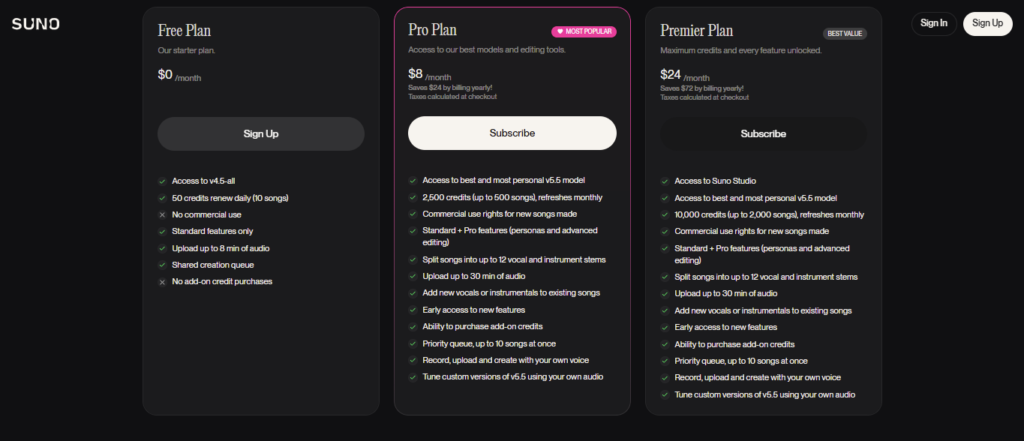
Pro at $8/month is competitive for a product that provides commercially licensed background music. Stock music licensing from traditional libraries costs far more per track — even mid-tier stock music platforms charge $10–50 per track for commercial licenses. For high-volume content creators who need original background music regularly, Suno Pro is dramatically cheaper than traditional alternatives.
Premier at $24/month makes sense for creators publishing several videos per week who want stronger claim protection and higher monthly generation volume.
Strengths: Outstanding for lo-fi, acoustic, cinematic, and country genres; fast generation; Custom Mode for lyrical control; competitive commercial licensing pricing vs stock music; free tier genuinely usable for evaluation.
Weaknesses: Rap flow quality degrades at high word counts; EDM outputs are genre-correct but generic; heavy rock distortion sounds processed; commercial licensing is tier-gated; Content ID issues are possible even with commercial rights; not an ownership arrangement at any tier.
Strong use cases: YouTube video backgrounds, podcast intros/outros, social media content music, indie game audio, personal projects where budget for licensed music doesn’t exist.
Weak use cases: Music you intend to release as a standalone single or album, situations requiring unambiguous copyright ownership, genres where Suno’s quality ceiling falls short of your standard (technical rap, metal, complex electronic music).
Does Suno generate vocals or just instrumentals?
Both. Default mode generates vocals and lyrics together. Custom Mode lets you provide lyrics; Suno generates the vocal performance. Instrumental-only generation is available as an option when you don’t want vocals.
Can I edit the tracks Suno generates?
Suno provides some in-platform editing (extend song, remix, inpaint a section), but it’s not a full DAW. For serious editing, tempo changes, stem extraction, and adding real instruments, you’ll need to export and edit in Audacity, GarageBand, or a professional DAW.
Will Suno tracks get copyright claimed on YouTube?
Possibly, even with commercial rights. Content ID matches can happen. Suno offers dispute assistance for Pro and Premier subscribers. The risk is real but manageable for most content creators.
Is there a mobile app?
As of April 2026, Suno is browser-based only. The mobile browser experience is functional but generation management is easier on desktop.
Suno AI is a legitimate production tool for content creators who need original background music at volume. The quality ceiling is real; it won’t replace session musicians or professional composers for demanding projects, but for background tracks, intros, outros, and ambient underscore, the output is good enough for professional content at a fraction of the cost of licensed alternatives.
The commercial licensing model is workable for most YouTube creators at the Pro tier. Premier makes sense for high-volume publishers. The free tier is one of the more honest free offerings in the AI tools space, you get enough credits to genuinely evaluate quality before committing money.
If you want to explore the broader AI music landscape before deciding, our guide to the best AI productivity tools for content creators covers complementary tools that work well alongside AI music generation in a complete content workflow.