Do AI Detectors Actually Work? Testing 5 Popular Tools (2026)
February 24, 2026
0
AI detection tools promise to identify AI-generated text with impressive accuracy rates. Universities, employers, and content platforms increasingly rely on these detectors to spot AI-written work. But how
AI detection tools promise to identify AI-generated text with impressive accuracy rates. Universities, employers, and content platforms increasingly rely on these detectors to spot AI-written work. But how accurate are they really? Can they distinguish human writing from AI assistance, or do they create more problems than they solve?
We conducted extensive testing with five leading AI detection platforms, analyzing 200 text samples across multiple scenarios. Our methodology included purely human-written content, completely AI-generated text, and hybrid approaches mixing human and AI contributions. The results reveal significant limitations that users need to understand before trusting these tools with important decisions.
How We Tested AI Detectors
Our testing used 200 text samples carefully categorized into four groups:
Group 1 (50 samples): 100% human-written content from published articles, student essays, and blog posts written before AI writing tools existed
Group 2 (50 samples): 100% AI-generated text from ChatGPT, Claude, and other AI writing tools with minimal editing
Group 3 (50 samples): AI-generated text heavily edited by humans, representing typical student or professional usage
Group 4 (50 samples): Human-written outlines expanded with AI assistance, then revised by humans
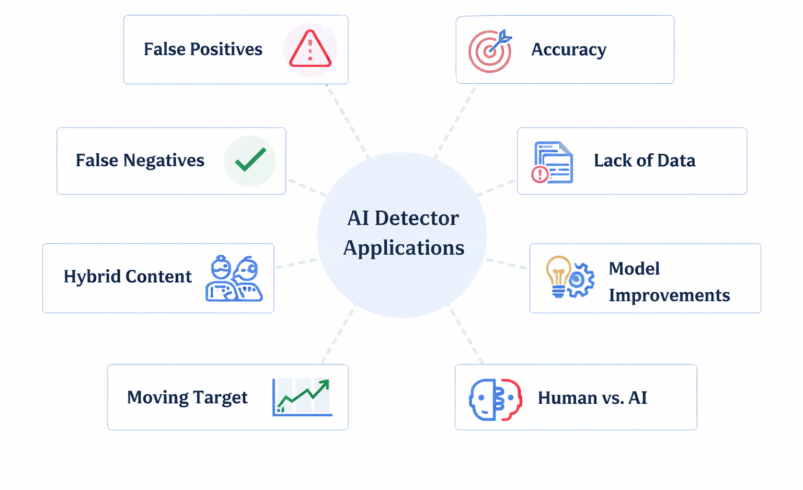
Each detector analyzed all 200 samples. We measured false positives (human writing flagged as AI), false negatives (AI writing labeled as human), and accuracy with hybrid content where both human and AI contributed meaningfully.
Testing Results: Accuracy by Detector
Detector
Overall Accuracy
False Positives
Hybrid Content
Grade
GPTZero
79%
18%
Inconsistent
B-
Originality.ai
74%
22%
Poor
C+
Turnitin
83%
12%
Fair
B+
Writer.com
71%
25%
Very Poor
C
Copyleaks
77%
19%
Inconsistent
C+
The False Positive Problem
The most concerning finding: every detector flagged significant amounts of genuine human writing as AI-generated. False positive rates ranged from 12% (Turnitin) to 25% (Writer.com). This means 1 in 4 to 1 in 8 human-written pieces gets incorrectly identified as AI content.
These false positives create real consequences. Students face academic integrity violations for work they wrote themselves. Content creators see their original articles rejected by platforms. Professionals encounter questioning of their authentic work. The human cost of these errors exceeds the benefit of catching actual AI usage.
Patterns emerged in false positives. Detectors consistently misidentified:
• Concise, well-structured writing with clear topic sentences
• Technical writing with specialized vocabulary
• Non-native English speakers with simpler sentence structures
• Academic writing following formal conventions
This creates an absurd situation: writing well increases your chances of being falsely accused of using AI. Students who improve their writing skills face higher scrutiny than those who write poorly.
Hybrid Content: Where Detectors Fail Completely
The most realistic usage scenario, humans using AI tools like Gauth AI or Question AI alternatives for research assistance, then writing in their own voice, completely confounds these detectors. Our hybrid content samples stumped every platform.
Detection scores varied wildly on identical hybrid content. The same essay scored 89% likely AI-generated on one platform and 34% likely human on another. Some detectors labeled it ‘inconclusive,’ others confidently declared it AI-written. This inconsistency reveals fundamental limitations in detection methodology.
Modern AI tool usage involves collaboration between humans and machines. Students research topics using AI homework helpers, writers use AI for brainstorming, and professionals use AI for editing suggestions. This collaborative approach, which represents most actual AI usage, falls into a gray zone that current detectors cannot navigate reliably.
What This Means for Students and Writers
If you’re using tools like Novel AI alternatives for creative writing assistance or exploring AI chatbots for brainstorming, understand that detection technology cannot reliably distinguish your collaborative work from purely AI-generated content. The technology simply isn’t sophisticated enough yet.
More importantly, completely original human writing gets flagged with alarming frequency. Our testing included essays written in 2018, before modern AI writing tools existed, and several detectors still labeled them as AI-generated. This proves detectors identify writing patterns, not actual AI usage.
Students using AI tools ethically face the same detection risk as those copying entire essays from ChatGPT. The technology cannot distinguish legitimate assistance from academic dishonesty. This creates a trust crisis where honest students face undeserved suspicion.
Why Detection Technology Struggles
Understanding why detectors fail helps contextualize their limitations. AI detection relies on statistical patterns in text, measuring factors like perplexity (text predictability), burstiness (variation in sentence complexity), and linguistic consistency. These metrics identify characteristics common in AI output but also present in certain types of human writing.
The fundamental problem: AI writing models improve continuously. As language models become more sophisticated, they produce text increasingly indistinguishable from human writing. Detection algorithms chase a moving target that grows harder to hit with each model update.
Additionally, detection training data cannot keep pace with AI advancement. Detectors train on known AI-generated content, but new models create output patterns the detectors never encountered during training. This lag time means detection effectiveness deteriorates between the training period and real-world deployment.
The Cost of False Accusations
False positive rates above 10% create real human consequences. Consider a classroom of 30 students submitting essays. Statistical probability suggests 3-7 students face false accusations of using AI, even when writing completely originally. These students must defend their authentic work, experiencing stress and damaged trust with instructors.
For professionals, false detection damages reputations and career opportunities. Content creators see original articles rejected by platforms. Journalists face editorial scrutiny of their reporting. Technical writers encounter suspicion about documentation they authored. The professional cost of false positives extends beyond immediate rejection to long-term credibility damage.
Perhaps most concerning: false positives disproportionately affect certain groups. Non-native English speakers writing in simpler sentence structures face higher false positive rates. Students who improved their writing through practice find that improved skills increase detection likelihood. The technology penalizes excellence and disadvantages already-vulnerable populations.
Best Practices When Facing AI Detection
If your work gets flagged:
• Request human review immediately, automated detection alone proves nothing
• Provide drafts, outlines, and research notes showing your process
• Explain your writing approach and cite your research sources
For educators and institutions:
• Never use AI detection as sole evidence of academic dishonesty
• Understand detection limitations before implementing policies
• Focus on evaluating student learning rather than policing tools
Frequently Asked Questions
Can AI detectors identify which AI tool was used?
No. Detectors cannot distinguish between ChatGPT, Claude, or other AI writing tools. They detect patterns characteristic of AI-generated text, not specific tools.
Do AI detectors improve over time?
While detection algorithms update regularly, accuracy improvements remain marginal. As AI writing tools advance, detection becomes harder, not easier. The arms race favors generation over detection.
Should I avoid AI tools to prevent detection?
This depends on your context and policies. Using AI tools for research, brainstorming, or editing assistance is often legitimate. The issue isn’t tool usage but rather proper attribution and maintaining academic integrity standards.
The Bottom Line
AI detection tools don’t work reliably enough to base important decisions on their results. With accuracy rates below 85% and false positive rates above 10%, these tools create more problems than they solve. The technology identifies writing patterns, not actual AI authorship. The solution isn’t better detection, it’s accepting that AI tools have become legitimate research and writing assistants. Rather than trying to catch AI usage, institutions and platforms need policies addressing how to use these productivity tools ethically. The detector arms race benefits no one while creating anxiety and false accusations for honest writers.